
(DN) – From July 1, 2025, Con Co Island District became Con Co Special Economic Zone – one of Vietnam’s 13 special economic zones. Dubbed a “green fortress” in the East Sea, Con Co not only holds a vital strategic position as a frontline outpost at the gateway to the Gulf of Tonkin, but also boasts great potential for economic and tourism development.
In May 2025, a delegation from the Binh Phuoc Provincial Journalists’ Association (formerly Binh Phuoc Province, now part of Dong Nai Province) visited Con Co Island District, before Quang Tri Province merged with Quang Binh Province. At Cua Viet Port, Major Tran Manh Khuong, Deputy Chief of Staff of the Con Co District Military Command, welcomed the group and guided them aboard the high-speed boat Chin Nghia. From the mainland to Con Co, there are only two high-speed boats: Con Co Tourist and Chin Nghia.
Because of an inconvenient seat, I became seasick. Truly, there is no feeling worse than seasickness: a spinning head, pounding pain, and a stomach in turmoil. Even so, I noticed that most of the passengers were from Quang Binh and Quang Tri, their voices carrying the region’s distinct heavy accents. After about an hour and a half, the boat docked. Stepping out of the cabin, I was awestruck by the endless expanse of blue sky and sea, and especially by the dense, cool green canopy covering the entire island. Carried on the wind was the pungent, salty tang of the sea.
 |
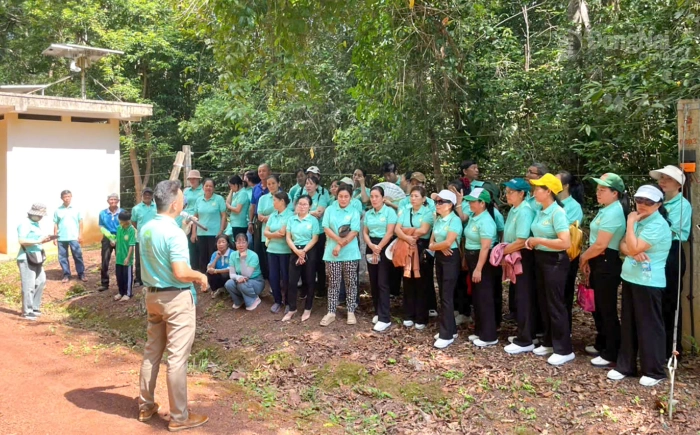
| Journalists took commemorative photos at the Con Co island heroes memorial. |
Lush green Con Co
Major Tran Manh Khuong became our guide during our stay on the island. Many in the group wondered how the entire island, made of rock, gravel, shell fragments, and coral, with soil unable to retain water, could be covered by such vast greenery.
We came from the Southeast region of Vietnam, an area already abundant in greenery, yet everyone was captivated by the poetic beauty of the island’s lush green foliage. Mr. Khuong said the island’s primary forest has been preserved, covering more than 70% of its total area. Con Co’s rare, untouched tranquility has become one of its greatest advantages. Today, it is one of the few primary forests in Vietnam that still retains an almost intact three-tier tropical rainforest ecosystem. For this reason, Con Co is known as the “green pearl” of the East Sea.
 |
| The author beside a pristine beach on Con Co island. |
The greenery not only offers a wild, peaceful beauty but also provides great ecological and geological value to the island. To maintain this, monthly cleanup efforts are organized by agencies, organizations, and residents to remove plastic waste along the shores. Saturday Volunteer Days, Green Sunday Programs, and campaigns like “Clean the sea” and “Bring your trash home” enjoy enthusiastic participation from officials, soldiers, locals, and tourists alike. Whether by the coast or in the island’s administrative center and residential areas, trash bins, often with organic waste sorting, are neatly placed under cool maple trees.
Mr. Khuong took us to visit a cluster of 17 ancient trees on the island that have been recognized as Vietnam Heritage Trees. Each tree is fenced off and bears a heritage plaque. This site marks an important milestone in strategies for natural conservation, eco-tourism development, and the protection of maritime and island sovereignty.
In the afternoon, we traveled through the primary forest. As the vehicle passed beneath the dense canopy, everyone was delighted to feel the temperature drop by 3 to 4 degrees Celsius compared to outside. It had likely been a long time since members of the delegation had the chance to breathe such fresh air while exploring a primary forest in the middle of the open sea, with its many layers of trees, vines, and remarkably rich vegetation.
Residents hope that with its designation as a special economic zone, the island, while maintaining its strategic role in national defense, will achieve a significant breakthrough in marine economic and tourism development.
Visit once, always remember
As the vehicle rolled along patrol roads through the forest, past the boat shelter, breakwater, offices, schools, and homes, I found myself thinking that every kilogram of steel, every bag of cement brought the 15 nautical miles (about 30 kilometers) to the island had been paid for with the sweat, effort, and even the blood and tears of soldiers, the first volunteer youth teams, and the earliest residents who came to build this frontline island.
 |
| Journalists took commemorative photos at the Con Co island national flagpole. |
I met Ms. Lan, one of 43 youth volunteers from the Quang Tri Provincial Youth Volunteer Corps who came to help build the island in 2002. In front of her family’s eatery, under the glow of streetlights, she recalled clearing fields of boulders to construct the island’s first roads, enduring dry summers when fresh water was scarce, and meals of dried fish with a few wild greens foraged from the forest. Things are different now. Her two children, one in university, the other in high school, study on the mainland. The family’s daytime eatery and evening drink service, though not as busy as businesses on the mainland, still provide enough for them to live comfortably and support their children’s education. Bit by bit, the sweat of soldiers, officers, and island residents, including Ms. Lan and her husband, is shaping the form of a port town, still quiet today, but steadily growing.
All delegation members noted that the island’s eateries served meals with an honesty and simplicity rarely seen.
For the first time, we tasted king oyster - a specialty known for its size, several times larger than normal oysters, sweet aroma, firm texture, found only on Con Co island. Some dishes like rice, soup, and fresh vegetables can be refilled free of charge. There was no sign of the “extravagant presentation” or “price gouging” seen in many mainland tourist spots.
Knowing I was visiting Con Co, Mr. Nguyen Dinh Manh, a university friend who is now Deputy Head of the Movements Department of the Vietnam Study Promotion Association, asked me to take a photo of Hoa Phong Ba Kindergarten and Primary School. He proudly recalled that in 2015, he was part of a delegation from the Ministry of Education and Training and the Vietnam Oil and Gas Group that attended the inauguration of this five-billion-dong school. Seeing firsthand the first generation of children born on this frontline island studying in such a spacious, modern school deeply moved him and the other members of the delegation.
 |
| Children from Hoa Phong Ba kindergarten and primary school visit the traditional house. |
Becoming a special economic zone has opened a promising new chapter for Con Co Island. This change is not merely administrative, but marks an important turning point in its development history, creating major opportunities to harness the island’s marine tourism potential as its most prominent strength. The top priority for Con Co Special Economic Zone remains the dual mission of developing the marine economy and safeguarding national sovereignty. The zone’s economic development policies are designed in tandem with livelihood support for residents and the assurance of national defense and security, thereby creating a sustainable development model that is both economically strong and secure in defense.
Our time on the island was short, but as we left, everyone felt an unusual sense of affection. From the boat deck, we looked back at the lighthouse, the national flagpole, the traditional house, the kindergarten, and the Con Co harbor, places where we had stopped to rest and take commemorative photos, slowly receding into the distance. Leaving Con Co, we carried with us the sparkling eyes of the Hoa Phong Ba Kindergarten and Primary School children, the warm smiles of soldiers, residents, and service workers on the island, and the belief that one day soon, Con Co Special Economic Zone will have a bustling port town.
By Linh Tam
Translated by Minh Hanh - Minho


Thông tin bạn đọc
Đóng Lưu thông tin