
After the merger, the new Dong Nai Province possesses not only a vast area but also many valuable mineral resources to support economic development, especially key infrastructure projects at the provincial, regional, and national levels.
 |
| Construction stone source serve the construction of Long Thanh International Airport. |
The province is reviewing and adjusting management and exploitation activities to use resources economically and efficiently.
Abundant mineral resources
After the provincial merger, Dong Nai has diverse and abundant resources. Especially, types of construction stone, sand, fill soil, and bauxite… have become great advantages for developing the building materials industry, and metallurgy, meeting the demands for large-scale infrastructure projects.
According to statistics from the Department of Agriculture and Environment, the province currently has 84 valid mineral exploitation licenses. Among them, construction stone has an approved total reserve of more than 577 million m³, with about 412 million m³ left from the end of 2024. Construction sand amounts to about 6 million m³, with 2.7 million m³ left. Notably, nearly 921,000 m³ of fill material minerals remain mostly unexploited.
Besides the permitted mineral reserves mentioned above, in order to meet urgent material needs for major projects (Long Thanh International Airport, Ho Chi Minh City’s Ring Road 3, Bien Hoa – Vung Tau Expressway), many mines in the province have been allowed to increase extraction capacity by 50% compared to the current level under a special mechanism, enabling actual quarrying and fill material production to exceed the licensed volumes.
Besides common minerals, Dong Nai also has strategic potential mineral resources such as bauxite. According to decisions approved by the Prime Minister, the province has four bauxite mines covering a total planned area of nearly 76,000 hectares, with reserves of more than 312 million tons of ore, along with 4 reserve zones covering over 14,000 hectares.
Furthermore, Decision No. 1626/QĐ-TTg dated December 15, 2023, approving the plan for exploration, exploitation, processing, and use of minerals as building materials for the 2021-2030 period, with a vision towards 2050, identified 35 planning areas in the province with a total area of nearly 2,900 hectares, and total reserves of more than 1.5 billion tons of resources (limestone, cement additives, kaolin, ornamental stone, peat…), among which limestone accounts for more than 724 million tons.
With a strategic and long-term vision, the province has planned a total of 162 exploitation zones, of which construction stone accounts for 111 zones with reserves exceeding 1.2 billion m³, a significant resource for construction industry and infrastructure development.
Nguyen Thi Hoang, Provincial Party Committee member and Vice Chairman of the Provincial People’s Committee, commented: Dong Nai is a province rich in mineral resources. Exploitation to serve infrastructure works, reduce imports, and promote development of the building materials industry is necessary, but it must balance economic development with environmental protection.
Efficient use linked to environmental protection
For many years, the former Dong Nai and Binh Phuoc provinces have focused on managing, exploiting, and using resources economically while protecting the environment. The province has delineated more than 5,100 prohibited mining zones, covering over 169,000 hectares, including special-use forests, national defense and security lands, traffic safety corridors, residential areas, industrial zones, and heritage sites.
Additionally, there are 238 temporarily prohibited mining zones covering more than 8,300 hectares. This zoning both protects ecosystems and preserves mineral reserves for the future, creating a balance between exploitation and conservation.
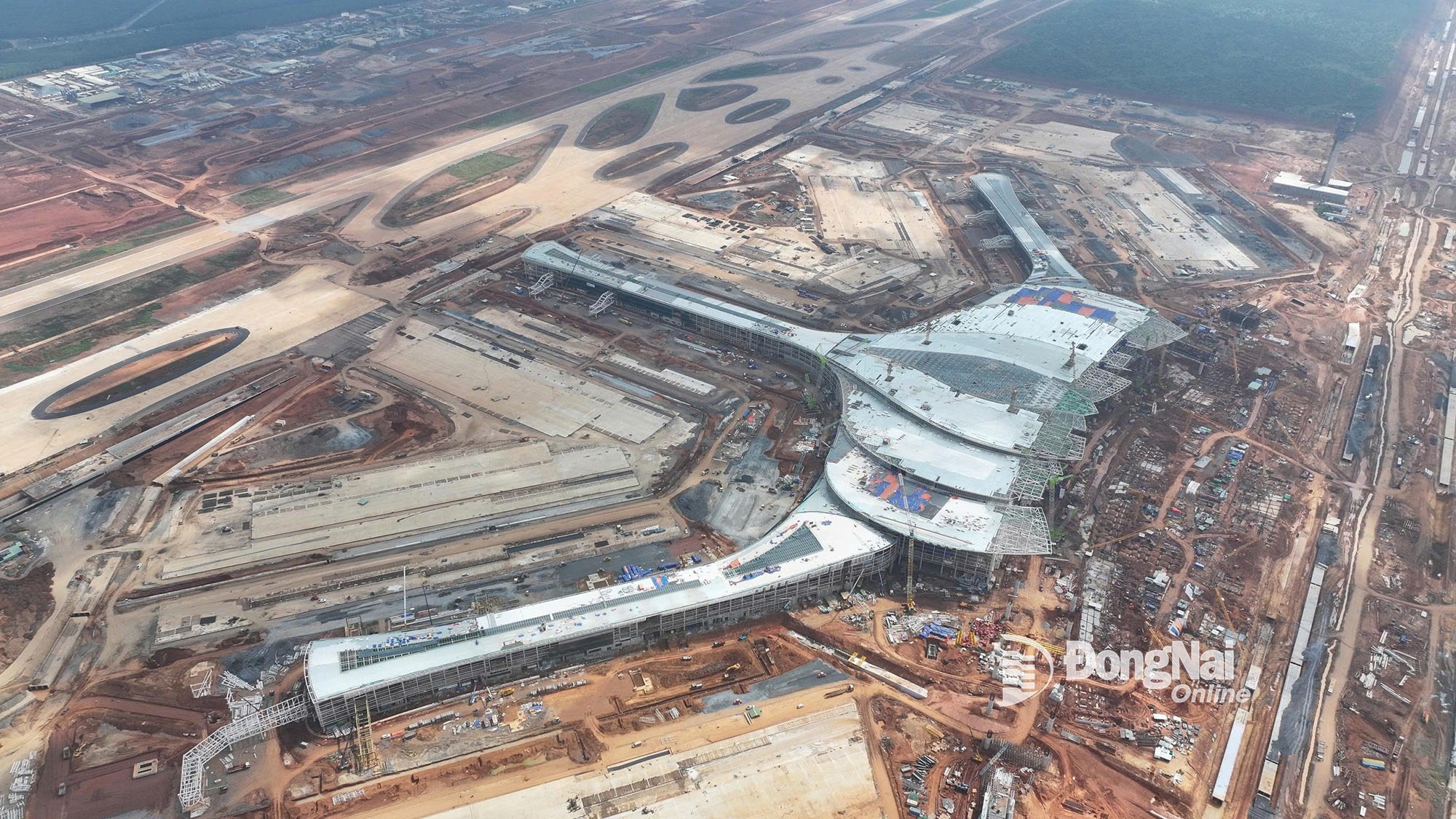 |
| Long Thanh International Airport project, a work requiring large quantities of construction stone and fill soil within the province. |
Mineral resources in Dong Nai currently play an important role in supplying raw materials for key national projects such as airports, seaports, expressways, ring roads, industrial zones, urban areas, and civil construction in the province and the Southern region.
To date, many units have been allocated building materials for major projects such as: My Thuan Project Management Board (620,000 m³), Ho Chi Minh City Project Management Board (747,000 m³), former Long An Project Management Board (475,000 m³). In addition, other road and expressway project investors and contractors are also requesting support for millions of cubic meters of materials.
In mid-July 2025, when supervising the planning, management, and use of land for the 2021-2025 period in Dong Nai Province, Provincial Party Committee member and Deputy Head of the specialized delegation of the Provincial National Assembly Delegation Dieu Huynh Sang noted: The province needs to review bauxite exploitation planning in the former Binh Phuoc, as it involves a large land use and overlaps with the planning of 3 types of forests. After review, reasonable zoning for exploitation is required to improve land use efficiency and reduce impacts on residents.
Regarding this issue, Provincial Party Committee member and Director of the Department of Agriculture and Environment Nguyen Tuan Anh said: After the merger, the department reviewed and reported to the Provincial People’s Committee proposing the Ministry of Agriculture and Environment adjust land use quotas, including land for mineral exploitation. The department proposed reducing about 78,500 hectares of land for mining activities compared to the demand of former Binh Phuoc, including bauxite mining land. This area will remain as agricultural land.
In the coming time, the province will continue adjusting planning, updating reserves, auctioning mining rights in accordance with regulations. Along with that, it will strengthen management to minimize illegal exploitation, resource loss, and environmental pollution. The provincial government directs functional sectors to supervise and ensure mineral priority for key provincial and Southern regional projects before allowing sales outside the region.
By Le An
Translated by Minh Hanh – Thu Ha


Thông tin bạn đọc
Đóng Lưu thông tin